

How Can Plumbers Own Search Results for Every Major Service?
Sep 18, 2026


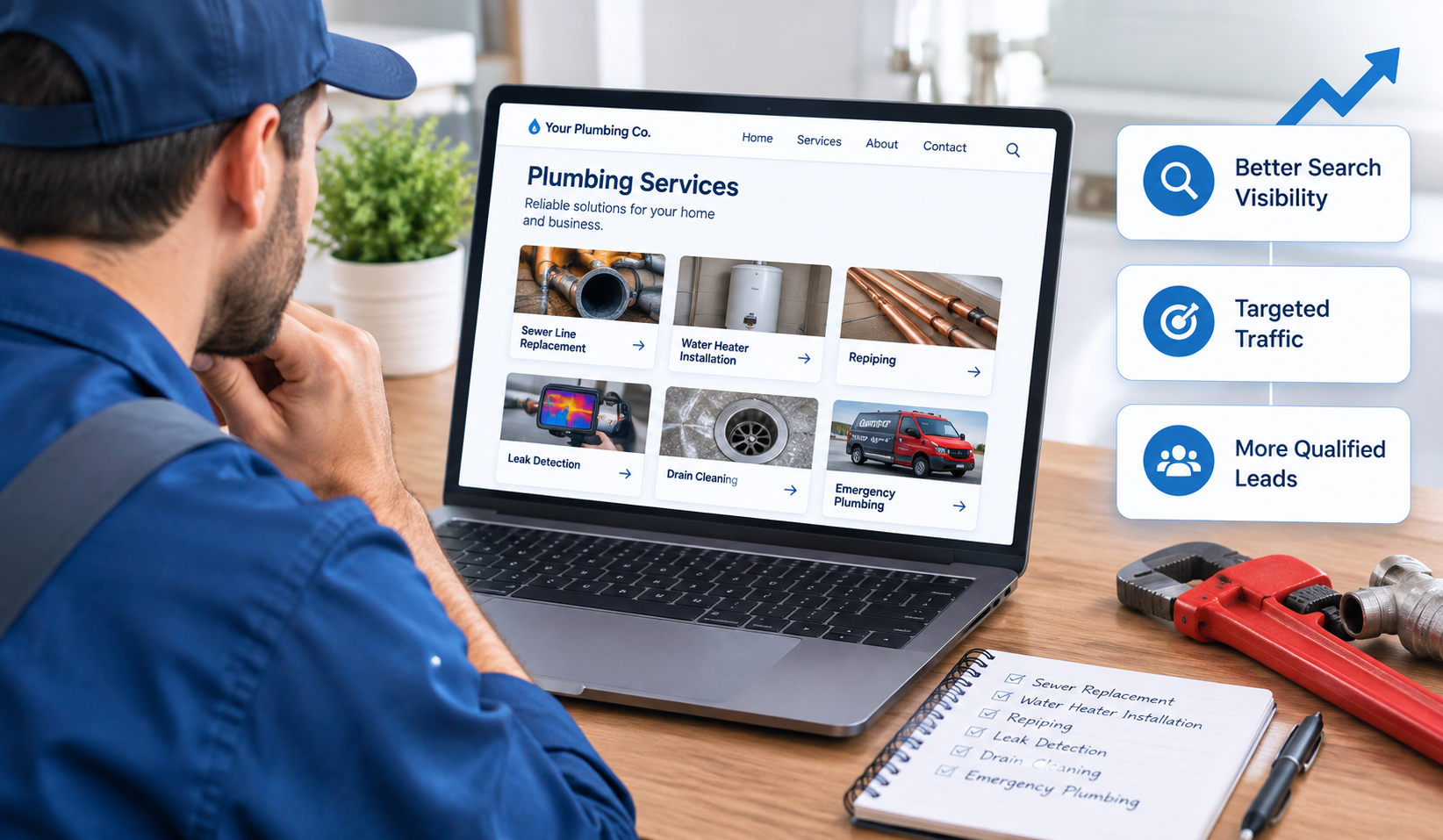
A plumbing website can offer dozens of services, but that does not mean every service should be placed on one general services page. When your business generates significant revenue from services such as sewer line replacement, water heater installation, repiping, leak detection, drain cleaning, or emergency plumbing, each important service deserves enough space to explain its value.
A dedicated service page gives search engines a clearer understanding of what you offer and gives customers a more relevant answer to what they are searching for. Instead of forcing one page to target multiple unrelated search intents, you can create focused pages that address specific plumbing problems, services, locations, and customer questions.
This approach is especially important when you want your website to compete for high-intent searches and generate qualified leads rather than simply increase website traffic.
Imagine your website has one page titled “Plumbing Services” containing short descriptions of 15 different services. The page may mention water heaters, sewer repair, drain cleaning, repiping, leak detection, emergency plumbing, and more.
The problem is that each service represents a different search intent.
Someone searching for “water heater replacement” wants information about replacement options, costs, signs of failure, installation, and availability. A person searching for “sewer line repair” has completely different concerns.
A general services page may mention both services, but it cannot provide the depth required for both.
Separate pages allow you to create focused resources around individual services and give both search engines and customers a clearer understanding of your expertise.
High-value services are generally services that generate substantial revenue, have strong customer demand, require specialized expertise, or produce highly qualified leads.
Depending on your plumbing business, these could include:
Not every service needs an individual page immediately. Your priority should be the services that matter most to your business and have a meaningful opportunity to attract customers through search.
Search engines need to understand the subject and purpose of each page. A dedicated service page makes that easier because the content can stay focused on one primary topic.
For example, a page targeting “water heater replacement” can naturally discuss:
That level of topical relevance is difficult to achieve when water heater replacement is competing for space with 10 or 20 other plumbing services.
A well-organized website structure also supports broader SEO services for plumbing businesses by creating clearer relationships between your services, supporting content, and local search strategy.
Search intent is one of the most important reasons to separate your services.
Consider these searches:
Although all of these searches relate to plumbing, they do not represent the same customer journey.
Someone searching “why is my water heater leaking?” may still be researching.
Someone searching “water heater replacement near me” is much closer to contacting a plumbing company.
A dedicated page lets you create content that corresponds to the specific intent behind the service instead of presenting a generic description.
A dedicated page gives you room to build a keyword strategy around one service.
For example, a water heater page could naturally target variations such as:
The objective is not to repeat these phrases unnecessarily. Instead, the page should naturally cover the concepts and questions customers associate with the service.
This creates a stronger topical relationship between the service, customer problem, location, and solution.
Local customers often search for a specific service rather than simply searching for “plumber.”
For example, a customer may search for:
“sewer line repair near me”
instead of:
“plumber near me.”
A dedicated sewer repair page gives your business a more relevant destination for that search.
Your service page can explain:
However, avoid creating dozens of nearly identical city pages simply by replacing the location name. Local pages should provide genuinely useful information about the service and the area.
A strong plumbing website should not stop with a service page.
You can build a topic cluster around your most valuable services.
For example, a sewer line service page could be supported by articles about:
These supporting articles can naturally link back to the primary service page using descriptive anchor text.
For example, instead of using “learn more,” use an anchor such as “professional sewer line repair services” when the link genuinely leads to that service page.
This creates a logical relationship between educational content and commercial service content.
Creating a separate URL is not enough. The page needs useful, service-specific information.
Start by explaining exactly what the service involves and what types of problems it solves.
Avoid vague statements such as:
“We provide quality plumbing services.”
Instead, explain the actual service, situations that require it, and what customers can expect.
Address the symptoms that cause people to search for the service.
For example, a sewer repair page could discuss:
This makes the page more useful because it connects the service to the customer’s actual problem.
Explain what happens after the customer contacts your company.
Depending on the service, this could include:
Clear process information can reduce uncertainty and help potential customers feel more comfortable contacting the business.
Explain what the customer gains from solving the problem.
For example, a repiping page could discuss improved water flow, reduced leak risks, updated plumbing materials, and long-term system reliability.
High-value plumbing decisions require trust.
Where appropriate, include:
These elements can help demonstrate expertise and credibility.
Your service page should make it easy for visitors to take the next step.
Depending on the service, calls to action can include:
The CTA should match the customer’s intent instead of appearing as an aggressive sales message.
Creating 20 pages with almost identical content is not a strong SEO strategy.
For example, replacing “water heater repair” with “sewer repair” throughout the same template does not create meaningful expertise.
Each service page should answer different questions and provide information specific to that service.
A water heater page may discuss equipment types, installation, replacement timing, and efficiency.
A sewer page may need to discuss inspections, pipe damage, excavation options, root intrusion, and replacement methods.
The more distinct the customer problem, the more distinct the content should be.
Internal links help users and search engines discover related pages.
Suppose your website has:
These pages can be connected when the relationship is genuinely useful.
You might link from a water heater maintenance article to your tankless water heater installation services page when discussing replacement options.
Likewise, an article about recurring plumbing emergencies could link to your emergency plumbing services for urgent leaks and pipe failures page.
The anchor text should describe the destination accurately.
Avoid repeatedly using generic anchors such as “read more,” “learn more,” or “this page.”
Search is increasingly moving beyond traditional blue links.
Users may receive summarized answers through AI-powered search experiences and conversational platforms. This makes clear, structured, authoritative website information increasingly valuable.
A service page should make it easy to understand:
This clarity can support broader efforts involving professional Plumber SEO Services, particularly when your strategy includes local SEO, topical authority, entity signals, E-E-A-T, AEO, and GEO.
The goal should not be to write content solely for an AI system. Write genuinely useful content that is clear enough for customers, search engines, and AI-powered systems to understand.
More traffic is not automatically better.
A plumbing website receiving thousands of visits from people looking for general information may generate fewer opportunities than a website attracting fewer visitors who are actively searching for specific services.
A dedicated service page can target customers who already know what they need.
For example:
“What causes low water pressure?”
is primarily informational.
But:
“Whole house repiping service near me”
has a much stronger commercial intent.
By building dedicated pages around high-value services, you can create landing destinations for users further along in the buying process.
You can prioritize service pages using several factors.
Start with services that contribute significantly to your company’s revenue.
Determine whether people actively search for the service.
Services with strong transactional or commercial intent can be valuable targets.
Specialization
If your company has particular expertise in a service, give that expertise its own dedicated page.
Highly competitive services may require more comprehensive content and stronger authority signals.
A service that consistently generates calls or estimates may deserve greater SEO attention.
You do not need to create every page at once.
A practical approach is to organize services into three groups.
These are the services that generate the most valuable opportunities for your business.
Create detailed pages first.
These services may have moderate demand or support your primary services.
Build pages after the core service structure is established.
These can remain part of your main services page until there is enough search demand, revenue potential, or business importance to justify dedicated content.
This prevents your website from becoming bloated with unnecessary pages.
This makes it difficult to create comprehensive content around individual search intents.
A page with only 200 words and a phone number may not provide enough useful information for competitive services.
Templates can help with structure, but the actual service information should be unique and useful.
Simply changing city names is not a sustainable local SEO strategy.
Even excellent service pages can remain disconnected if the rest of the website never references them.
A page can rank and still fail to generate calls. Search visibility should ultimately support business outcomes.
Internal and external links should describe their destination naturally.
For example, “SEO strategies for plumbing companies” is more descriptive than “click here” when that is genuinely what the destination covers.
After publishing your service pages, monitor their performance.
Important metrics include:
The most important question is not simply:
“Did this page get traffic?”
Instead, ask:
“Did this page attract people who were looking for this service and create meaningful business opportunities?”
That shift helps you prioritize pages based on business value.
A new page may be worthwhile when:
If two services have nearly identical intent and customers expect the same solution, combining them may make more sense.
The goal is not to create the maximum number of pages.
The goal is to create the right pages for the right services and search intents.
A logical structure could look like:
Plumbing Services
→ Emergency Plumbing
→ Water Heater Services
→ Sewer Line Services
→ Drain Cleaning
→ Leak Detection
→ Repiping
→ Hydro Jetting
Then each major service can have relevant supporting content.
For example:
→ Water heater replacement
→ Tankless water heater installation
→ Water heater maintenance
→ Signs your water heater needs replacement
This structure helps visitors move from broad service discovery to specific solutions.
No. Create dedicated pages when a service has distinct search intent, meaningful business value, or enough information to justify comprehensive content. Closely related services can sometimes be combined.
Separate pages allow you to focus content, keywords, customer questions, and conversion opportunities around specific plumbing services rather than forcing multiple intents onto one general page.
Usually, yes. Emergency plumbing has a distinct intent because customers often need immediate assistance. A dedicated page can clearly explain emergency services, common situations, service areas, availability, and how to contact the business.
They can support local SEO by giving search engines and customers clearer information about specific services offered in particular service areas. The pages should provide genuine local value rather than repetitive location-based content.
There is no ideal number. Your website should have enough dedicated pages to properly cover important services without creating thin, repetitive, or unnecessary content. Prioritize services according to business value and search intent.
Your highest-value plumbing services should not be hidden inside a generic services page.
Each strategically important service can become a focused search asset that answers customer questions, demonstrates expertise, supports local visibility, and creates a direct path toward contacting your business.
If your website currently lists all services on one page, review which services generate the strongest revenue and customer demand. Those are the pages that deserve deeper content, stronger internal linking, clear conversion paths, and a focused SEO strategy.
For a more structured approach to SEO for plumbing businesses, evaluate your service architecture, keyword targeting, internal linking, local signals, and conversion strategy together rather than treating each page as an isolated SEO task.
When you are ready to build a search strategy around your most valuable plumbing services, Contact Us for a customized plumber SEO strategy focused on attracting relevant searches and turning service-specific visibility into qualified opportunities.
A plumbing website does not need dozens of pages simply for the sake of having more content. It needs strategically developed pages that reflect how customers actually search for plumbing solutions.
High-value services deserve dedicated pages when they have distinct search intent, strong business value, and enough depth to provide genuinely useful information.
By separating important services, creating unique and authoritative content, developing supporting topic clusters, using descriptive internal links, strengthening local relevance, and measuring lead generation, you can build a website that is easier to understand and more useful to potential customers.
The strongest plumbing SEO strategy is not about creating more pages. It is about creating better pages for the services your customers value most.